
Broad Grade Selection
Choose from crown, flint, low-dispersion, high-index, filter, radiation-resistant, and other specialized glass families.
A broad family of optical glasses selected by refractive index, dispersion, transmission, homogeneity, thermal behavior, and environmental requirements. COE Sapphire supports custom components in customer-specified or application-matched glass grades.
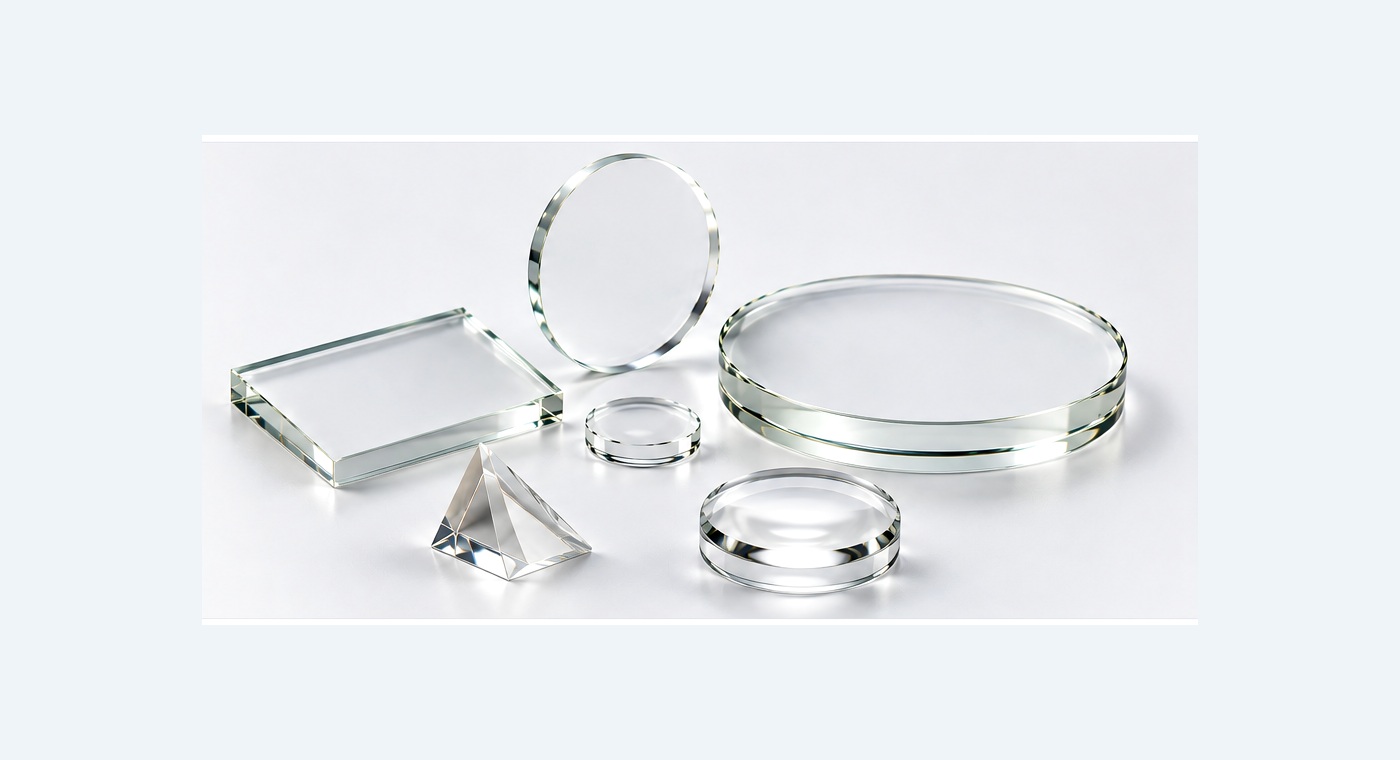
Optical glass is available in many controlled compositions, enabling engineers to balance refractive index, dispersion, wavelength range, weight, thermal response, chemical durability, and cost. This flexibility makes it suitable for lenses, prisms, windows, filters, and other precision optical components.
Choose from crown, flint, low-dispersion, high-index, filter, radiation-resistant, and other specialized glass families.
Catalog grades provide characterized refractive index and dispersion for repeatable optical design and production.
Optical glass can be ground, polished, edged, coated, cemented, and assembled into complex optical systems.
Many grades offer a practical balance of optical performance, availability, production scalability, and cost.
Optical glass is a material family rather than one fixed composition. Values below describe the principal parameters engineers should specify. Final properties must be confirmed for the selected manufacturer and glass code.
| Material Family | Crown, flint, high-index, low-dispersion, filter, and specialty optical glass |
|---|---|
| Density | Grade dependent |
| Hardness | Grade dependent; generally suitable for conventional precision optical processing |
| Thermal Expansion | Grade dependent and important for mounting and thermal cycling |
| Chemical Durability | Varies by composition and environmental exposure |
| Annealing Quality | Fine anneal and precision anneal options may be specified |
| Available Forms | Blocks, strips, plates, molded blanks, cut blanks, and finished components |
| Refractive Index | Selected by glass code and design wavelength |
|---|---|
| Abbe Number / Dispersion | Selected to control chromatic aberration |
| Transmission Range | Grade, thickness, purity, and coating dependent |
| Homogeneity | Standard through high-homogeneity grades |
| Stress Birefringence | Controlled through annealing and processing |
| Internal Quality | Bubbles, inclusions, striae, and fluorescence specified by grade |
| Coating Compatibility | AR, reflective, beamsplitter, filter, and custom multilayer coatings |
Different optical glass families are optimized for ultraviolet, visible, near-infrared, filter, or radiation-resistant performance. Transmission depends on glass code, thickness, surface finish, and coating.
| Selection Factor | Sapphire | BK7 | Fused Silica | Optical Glass Family |
|---|---|---|---|---|
| Grade Variety | Single-crystal material | Standard crown glass | Silica grades | Very Broad |
| Index / Dispersion Choice | Limited | Defined standard | Low index / low dispersion | Extensive |
| Environmental Durability | Excellent | Good | Excellent | Grade Dependent |
| Visible Optical Design | Very Good | Excellent | Excellent | Excellent |
| Cost Range | Higher | Low | Moderate | Broad |
COE Sapphire manufactures customer-specified optical glass components from prototypes through repeat production, with fabrication, coating, assembly, and inspection support.
Cutting, generating, edging, beveling, drilling, and custom geometry fabrication.
Flat, spherical, cylindrical, and custom polishing to application-specific surface requirements.
AR, reflective, beamsplitter, filter, and custom multilayer coatings.
Dimensional inspection, interferometry, surface inspection, and documentation.
Provide the preferred glass code or target optical constants, operating wavelengths, dimensions, tolerances, surface quality, wavefront or flatness, wedge, clear aperture, coating, quantity, and environmental conditions.
Discuss Your SpecificationIt refers to glass compositions manufactured with controlled optical constants, internal quality, homogeneity, and transmission for precision optical use.
Selection is based on refractive index, dispersion, wavelength range, thermal behavior, chemical durability, internal quality, availability, and cost.
No. BK7 is one widely used crown-glass grade. Optical glass includes many crown, flint, high-index, low-dispersion, filter, and specialty grades.
Yes. COE Sapphire can evaluate customer-specified grades or help identify suitable alternatives based on the application and required optical constants.
Windows, lenses, prisms, filters, mirrors, rods, plates, and custom geometries can be produced subject to grade availability and design requirements.
Yes. AR, reflective, beamsplitter, filter, and custom multilayer coatings can be matched to the selected glass and operating wavelength.
Send your glass code, target optical constants, drawing, wavelength range, coating, and quantity for engineering review.