
Broad Infrared Use
Useful transmission from approximately 0.4 or 0.6 to 12 µm, depending on grade and processing.
A pale yellow infrared material available in standard and multispectral grades for thermal imaging, defense, aerospace, and harsh-environment windows.
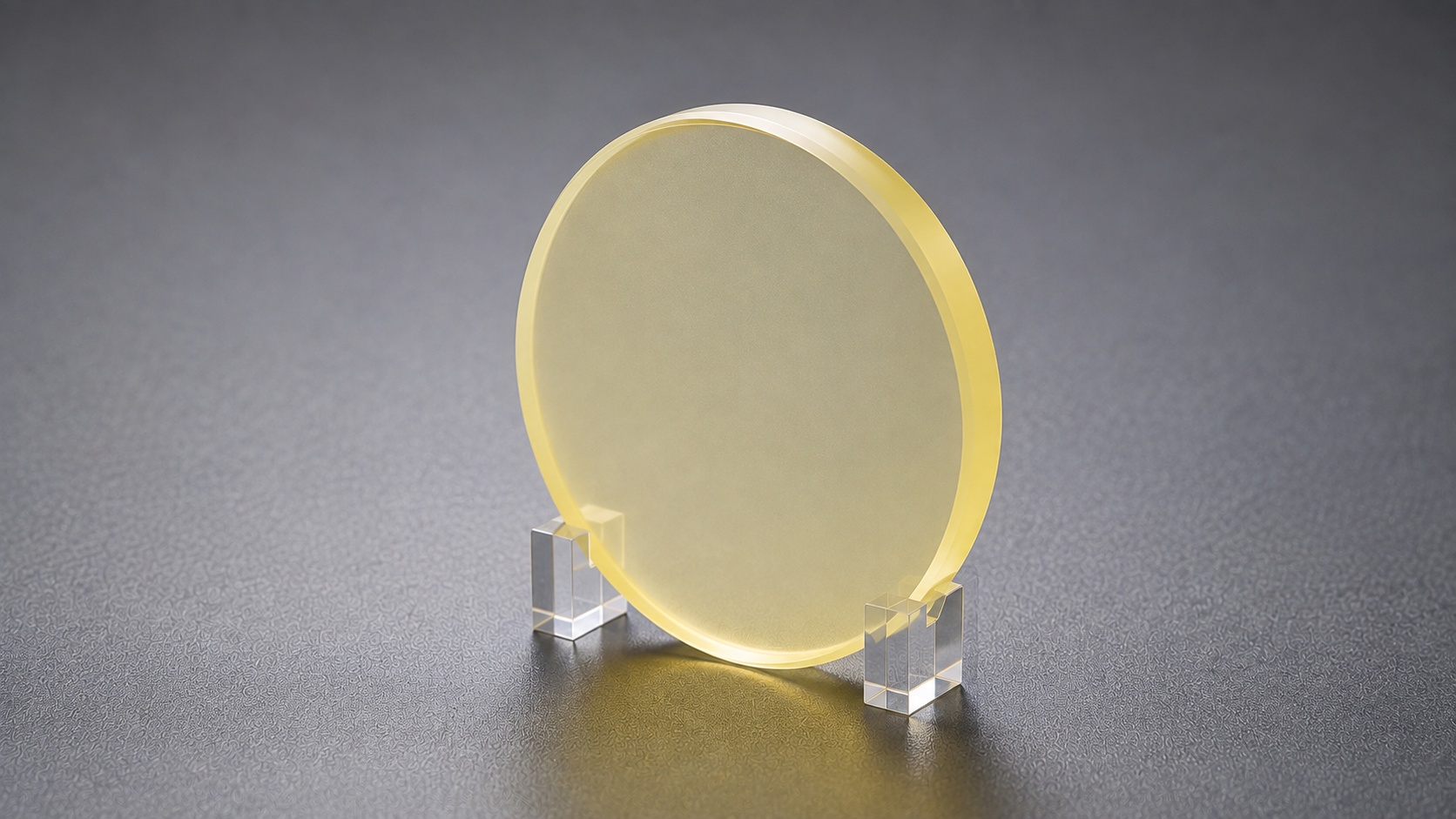
Zinc sulfide combines good mechanical durability, broad infrared transmission, and optional visible transmission in multispectral grades.
Useful transmission from approximately 0.4 or 0.6 to 12 µm, depending on grade and processing.
Special processing can improve visible and near-infrared transmission for multispectral imaging systems.
Better mechanical durability than ZnSe supports exposed windows and demanding field applications.
Supports visible, NIR, MWIR, LWIR, dual-band, and protective coating designs.
Representative values for optical-grade Zinc Sulfide (ZnS). Final values vary by material grade, wavelength, temperature, thickness, supplier specification, and test method.
| Chemical Formula | ZnS |
|---|---|
| Crystal Structure | Cubic or hexagonal; optical material is often polycrystalline |
| Density | Approximately 4.09 g/cm³ |
| Knoop Hardness | Approximately 160–220, grade dependent |
| Young’s Modulus | Approximately 74 GPa |
| Poisson’s Ratio | Approximately 0.28 |
| Thermal Expansion | Approximately 6.5 × 10⁻⁶/K |
| Melting / Sublimation | High-temperature behavior is process and grade dependent |
| Transmission Range | Approximately 0.4/0.6–12 µm, grade dependent |
|---|---|
| Refractive Index | Approximately 2.20 at 10.6 µm |
| Visible Appearance | Pale yellow to cream; multispectral grades may appear clearer |
| Scatter | Standard grade may exhibit more visible scatter than multispectral grade |
| Mechanical Durability | Good for an infrared transmitting material |
| Coating Compatibility | VIS/NIR/MWIR/LWIR AR, dual-band, filter, and protective coatings |
| Available Grades | Standard infrared and multispectral grades |
ZnS supports important infrared bands, while multispectral grades extend useful transmission into the visible for combined imaging systems.
| Property | Germanium | Silicon | ZnSe | Zinc Sulfide (ZnS) |
|---|---|---|---|---|
| Multispectral Capability | No | No | Visible but softer | Excellent in multispectral grade |
| Mechanical Durability | Good | Very Good | Moderate | Good |
| LWIR Performance | Excellent | Limited | Very Good | Very Good |
| Visible Scatter | Opaque | Opaque | Low | Grade dependent |
| Exposed Windows | Good with coating | Specialized | Limited | Very Good |
COE Sapphire supports prototype, low-volume, and repeat production of precision ZnS windows, domes, lenses, protective optics, and custom multispectral components.
Controlled cutting, edging, beveling, coring, and custom geometry fabrication for zinc sulfide.
Precision flat, spherical, aspheric, and custom polishing with process control for surface quality and edge integrity.
MWIR and LWIR anti-reflection, protective, filter, and diamond-like carbon coatings.
Dimensional inspection, interferometry, surface inspection, transmission verification, and documentation.
Provide optical grade, operating wavelength, dimensions, tolerances, surface quality, flatness or power, wedge or parallelism, clear aperture, edge treatment, coating, quantity, and environmental requirements.
Discuss Your SpecificationDepending on grade, ZnS can provide useful transmission from the visible or near infrared to roughly 12 µm.
Multispectral ZnS receives additional processing to improve visible and near-infrared transmission while retaining useful mid- and long-wave infrared performance.
ZnS is generally harder and more durable, while ZnSe offers lower absorption for CO₂ laser applications and a broader long-wave transmission range.
Yes. Its mechanical durability and multispectral availability make it useful for protective windows, sensor apertures, and demanding aerospace or defense environments.
Options include visible/NIR AR, MWIR/LWIR AR, dual-band, multispectral, filter, and protective coating systems.
Send us your drawing, specification, or application requirements.