
Excellent Optical Homogeneity
Uniform refractive index supports precision imaging and repeatable optical performance.
A widely used borosilicate crown glass offering excellent optical homogeneity, good mechanical durability, and economical performance for precision windows, lenses, prisms, and general imaging optics.
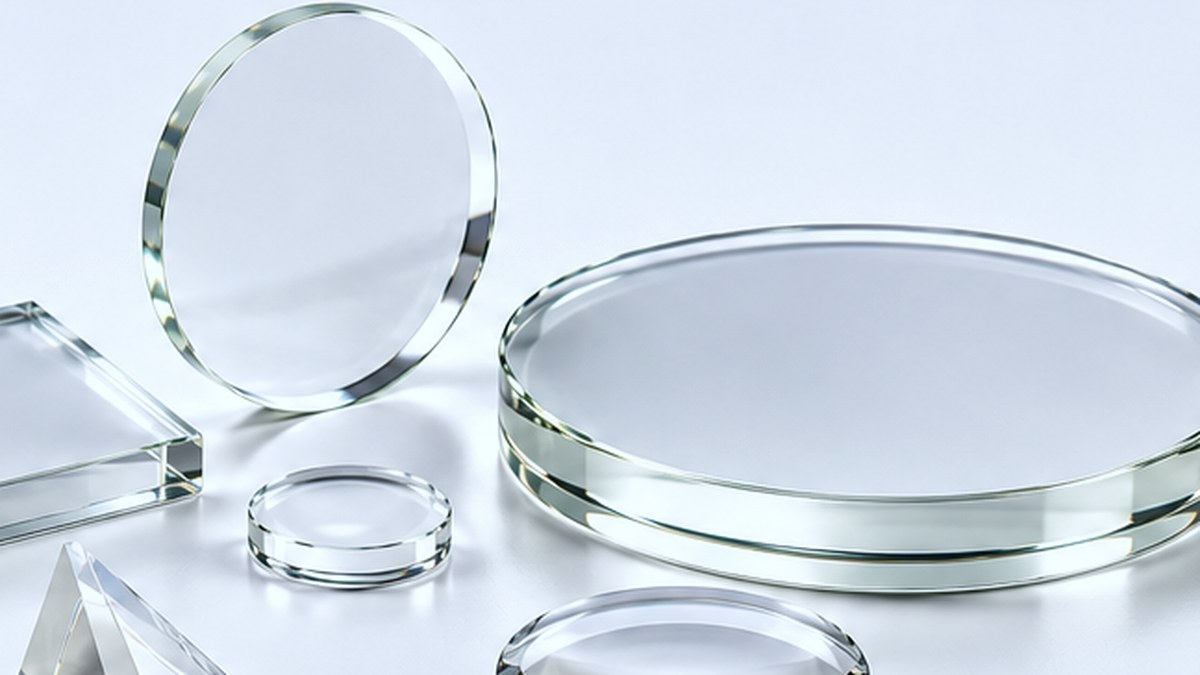
BK7 is one of the most commonly specified optical glasses because it combines consistent optical quality, broad visible transmission, good polishability, and practical cost. It is well suited to general-purpose imaging, laser, inspection, laboratory, and industrial optical systems.
Uniform refractive index supports precision imaging and repeatable optical performance.
High transmission across the visible spectrum and useful performance into the near infrared.
Machines and polishes efficiently into windows, lenses, prisms, filters, and custom shapes.
A practical material choice when sapphire-level hardness or deep-UV performance is not required.
Representative values for optical-grade BK7-type borosilicate crown glass. Final values vary by supplier, melt, grade, wavelength, and test method.
| Glass Type | Borosilicate crown optical glass |
|---|---|
| Density | Approximately 2.51 g/cm³ |
| Knoop Hardness | Approximately 610 |
| Young’s Modulus | Approximately 82 GPa |
| Poisson’s Ratio | Approximately 0.21 |
| Thermal Expansion | Approximately 7.1 × 10⁻⁶/K |
| Transformation Temperature | Approximately 557°C |
| Transmission Range | Approximately 0.35–2.5 µm, thickness-dependent |
|---|---|
| Refractive Index nd | Approximately 1.5168 |
| Abbe Number Vd | Approximately 64.17 |
| Dispersion | Low-to-moderate crown-glass dispersion |
| Birefringence | Isotropic glass; stress birefringence depends on processing |
| Coating Compatibility | AR, reflective, beamsplitter, filter, and custom coatings |
| Available Grades | Commercial, optical, precision, and high-homogeneity grades |
BK7 provides strong transmission throughout the visible range and useful near-infrared performance. Actual transmission depends on thickness, surface finish, absorption, and optical coating.
| Property | Sapphire | BK7 | Fused Silica | CaF₂ |
|---|---|---|---|---|
| Visible Imaging | Very Good | Excellent | Excellent | Very Good |
| UV Performance | Very Good | Limited | Excellent | Excellent |
| Scratch Resistance | Excellent | Moderate | Good | Low |
| Thermal Stability | Excellent | Moderate | Excellent | Moderate |
| Relative Cost | Higher | Low | Moderate | Higher |
COE Sapphire supports prototype, low-volume, and repeat production of precision BK7 optical components with integrated fabrication, coating, and inspection.
Cutting, edging, coring, beveling, centering, and custom geometry fabrication.
Precision flat, spherical, and custom polishing for demanding surface requirements.
AR, reflective, beamsplitter, filter, and application-specific multilayer coatings.
Dimensional inspection, interferometry, surface inspection, and documentation.
Provide operating wavelength, dimensions, tolerances, surface quality, flatness, wedge or parallelism, clear aperture, edge treatment, coating, quantity, and environmental requirements.
Discuss Your SpecificationBK7 is widely used for visible-light windows, lenses, prisms, filters, mirrors, beam splitters, and general imaging components.
BK7 typically offers useful transmission from approximately 350 nm into the near infrared, with the practical range depending on thickness and coating.
BK7 is generally more economical and easy to manufacture, while fused silica offers better deep-UV transmission, lower thermal expansion, and stronger thermal-shock performance.
BK7 is more cost-effective for many visible applications, while sapphire provides much greater hardness, abrasion resistance, and high-temperature capability.
Yes. BK7 is compatible with anti-reflection, reflective, beamsplitter, filter, and custom multilayer coatings.
Yes. COE Sapphire can manufacture custom dimensions, wedges, bevels, radii, apertures, holes, polished surfaces, and application-specific tolerances.
Please provide dimensions, tolerances, surface quality, flatness, wedge or parallelism, clear aperture, coating requirements, quantity, and any inspection documentation needed.
Send us your drawing, specification, or application requirements.