Broad IR Transmission
Selected compositions support MWIR and LWIR applications, with useful spectral ranges extending from the near infrared beyond 12 µm.
A family of infrared-transmitting glasses engineered for thermal imaging, sensing, spectroscopy, laser delivery, and precision molded optics.
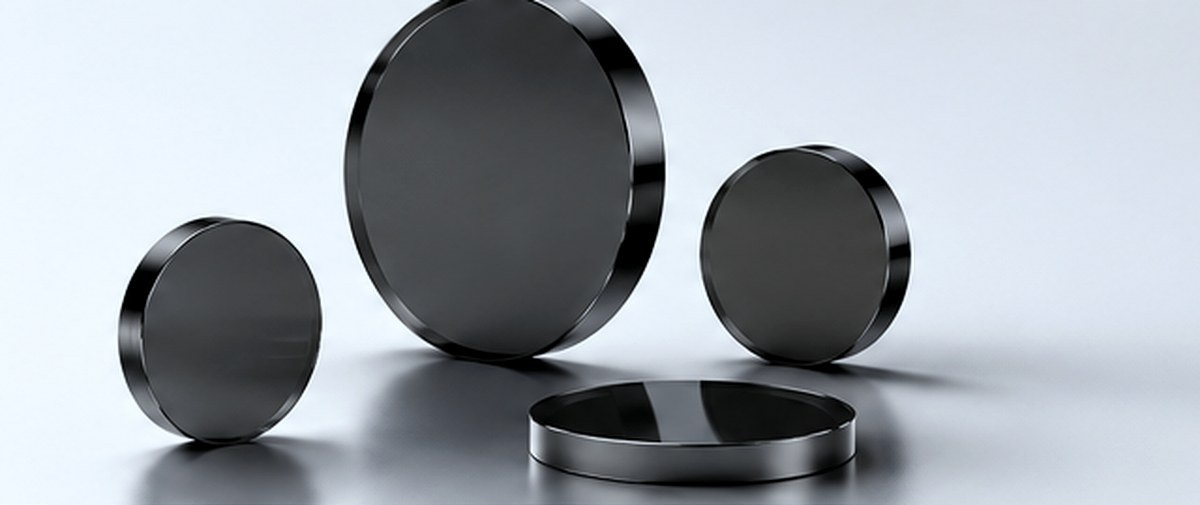
Chalcogenide glasses combine broad infrared transmission with glass-like processing and composition-dependent optical properties, giving designers an adaptable alternative to crystalline infrared materials.
Selected compositions support MWIR and LWIR applications, with useful spectral ranges extending from the near infrared beyond 12 µm.
Suitable grades can be precision molded into aspheric and diffractive surfaces for compact, high-volume optical assemblies.
Refractive index, dispersion, thermal behavior, and transmission vary by composition, enabling material selection around system priorities.
Supports polished prototypes, custom geometries, and scalable molded optics when the design and glass grade are compatible.
Chalcogenide glass is a material family rather than a single composition. Representative ranges below must be confirmed for the selected grade, wavelength, geometry, and operating environment.
| Material Family | Glasses based on sulfur, selenium, or tellurium systems |
|---|---|
| Structure | Amorphous glass |
| Density | Approximately 3.0–5.0 g/cm³, composition dependent |
| Hardness | Lower than sapphire and many crystalline IR materials |
| Thermal Expansion | Grade dependent; include in athermal design analysis |
| Glass Transition | Composition dependent and relevant to molding and service temperature |
| Environmental Response | Grade-specific sensitivity to moisture, abrasion, and thermal cycling |
| Transmission Range | Common grades span approximately 1–12 µm; selected grades extend farther |
|---|---|
| Refractive Index | Typically high, often approximately 2.2–3.5 in the infrared |
| Dispersion | Composition dependent; useful for IR achromatization |
| Visible Appearance | Usually dark and opaque in the visible spectrum |
| Reflection Loss | Significant when uncoated because of the high refractive index |
| Coating Compatibility | MWIR/LWIR AR, protective, filter, and custom spectral coatings |
| Available Grades | As-S, As-Se, Ge-As-Se, Ge-Sb-Se, and other engineered systems |
Material families and commercial grades can be evaluated according to spectral band, refractive index, dispersion, thermal behavior, environmental requirements, fabrication method, and availability.
Representative sulfur-, selenium-, and tellurium-based systems include As–S, As–Se, Ge–As–Se, and Ge–Sb–Se compositions.
Representative infrared chalcogenide glasses include IRG 22, IRG 24, IRG 25, IRG 26, and IRG 27.
Representative commercial materials include AMTIR-1, AMTIR-2, and AMTIR-8, with additional AMTIR grades available from the manufacturer.
Representative proprietary chalcogenide materials include BD2™ and BD6™ for molded or polished infrared optical components.
Transmission varies significantly across chalcogenide families. Material selection should begin with the operating band, absorption limits, temperature range, and required refractive-index behavior.
| Property | Germanium | ZnSe | ZnS | Chalcogenide Glass |
|---|---|---|---|---|
| IR Coverage | Broad MWIR/LWIR | Broad VIS–LWIR | VIS–LWIR, grade dependent | Broad, composition dependent |
| Refractive Index | Very high | Moderate | Moderate | High and tailorable |
| Precision Molding | No | Limited | Limited | Strong advantage |
| Mechanical Durability | Good | Moderate | Good | Grade dependent |
| Best Fit | Thermal imaging | Broadband optics | Multispectral windows | Compact molded IR optics |
COE Sapphire supports material selection, precision fabrication, optical finishing, coating, inspection, and integration for custom chalcogenide glass optics.
Controlled cutting, edging, generating, beveling, and custom geometry fabrication with brittle-material handling.
Precision polishing for prototypes and suitable aspheric or diffractive molding pathways for production designs.
MWIR and LWIR anti-reflection, protective, filter, and custom spectral coating options.
Dimensional inspection, surface metrology, transmission verification, cosmetic inspection, and documentation.
Provide operating wavelength and temperature, preferred glass grade, dimensions, tolerances, surface form and quality, clear aperture, edge treatment, coating, quantity, and environmental requirements.
Discuss Your SpecificationChalcogenide glass is an amorphous material containing one or more chalcogen elements such as sulfur, selenium, or tellurium, combined with network-forming elements to produce useful infrared optical properties.
The range depends on composition. Common infrared grades cover portions of approximately 1 to 12 µm, while selected compositions can extend beyond that range.
Chalcogenide glass generally offers lower refractive index and less density than germanium, plus precision-molding potential. Germanium remains a strong choice for many established LWIR systems and harsh-environment designs.
Yes. Compatible compositions can be molded into aspheric and diffractive surfaces, enabling compact designs and repeat production. Molding feasibility depends on geometry, tolerances, glass transition behavior, and volume.
Usually. Its relatively high refractive index creates significant surface reflection, so band-specific anti-reflection coatings are commonly used to improve system transmission.
Send us your drawing, wavelength band, glass preference, quantity, or application requirements.