Broad Spectral Range
Useful transmission from approximately 0.6 to 20 µm, depending on grade, thickness, and coating.
A yellow transparent polycrystalline material widely used for CO₂ laser optics, thermal imaging, spectroscopy, and broadband infrared windows.
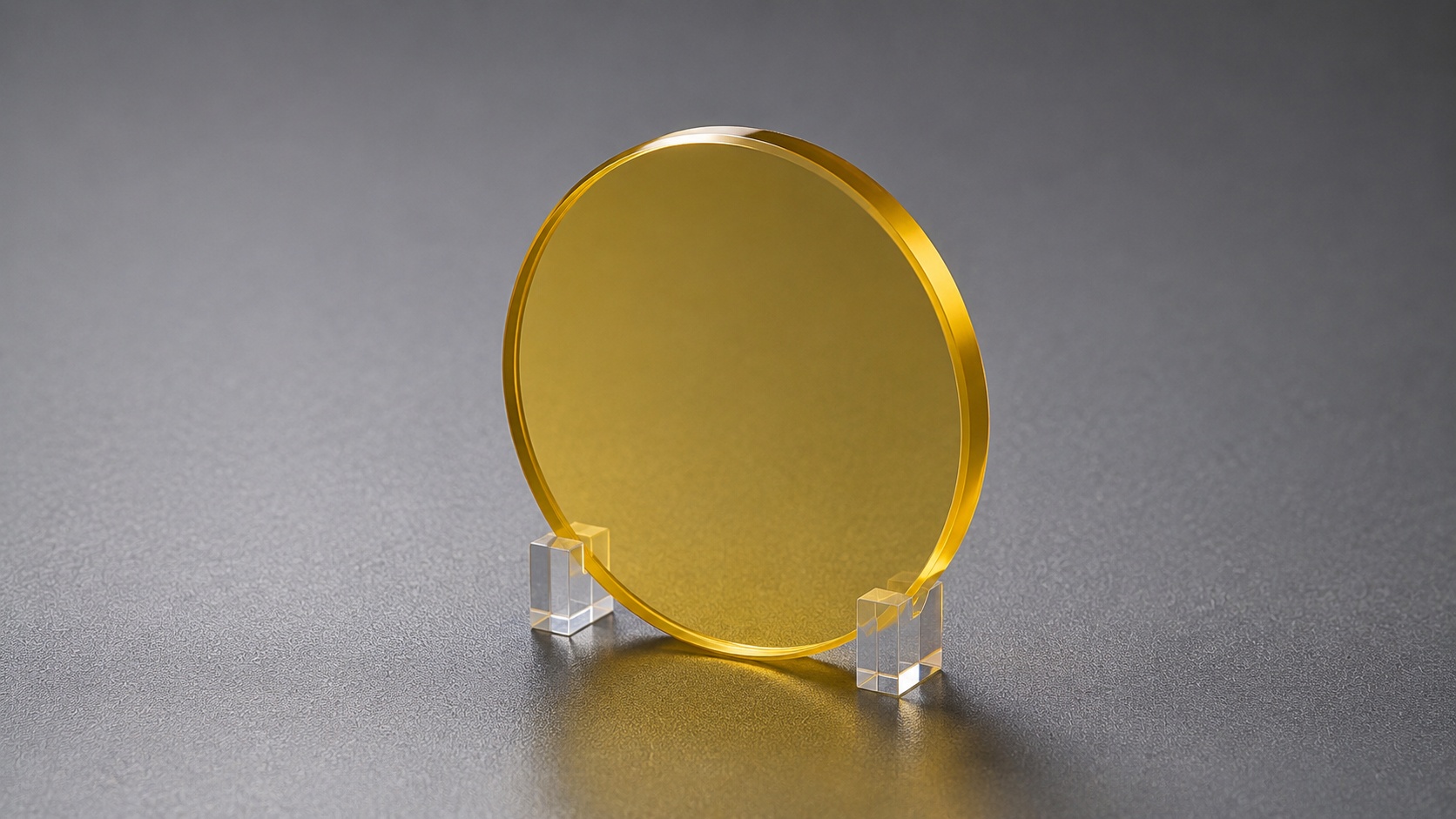
Zinc selenide combines visible transparency, broad infrared transmission, low absorption at CO₂ laser wavelengths, and strong coating compatibility.
Useful transmission from approximately 0.6 to 20 µm, depending on grade, thickness, and coating.
Low absorption near 10.6 µm makes ZnSe a standard material for high-power CO₂ laser windows and lenses.
Its yellow transparent appearance allows visible alignment in systems that also operate in the infrared.
Supports broadband AR, laser-line, beamsplitter, filter, and protective coating designs.
Representative values for optical-grade Zinc Selenide (ZnSe). Final values vary by material grade, wavelength, temperature, thickness, supplier specification, and test method.
| Chemical Formula | ZnSe |
|---|---|
| Crystal Structure | Cubic zinc blende, typically polycrystalline |
| Density | Approximately 5.27 g/cm³ |
| Knoop Hardness | Approximately 120 |
| Young’s Modulus | Approximately 67 GPa |
| Poisson’s Ratio | Approximately 0.28 |
| Thermal Expansion | Approximately 7.1 × 10⁻⁶/K |
| Melting Point | Approximately 1525°C, material dependent |
| Transmission Range | Approximately 0.6–20 µm, grade and thickness dependent |
|---|---|
| Refractive Index | Approximately 2.40 at 10.6 µm |
| Visible Appearance | Yellow to amber and transparent |
| Absorption at 10.6 µm | Low for laser-grade material |
| Dispersion | Moderate across visible and infrared bands |
| Coating Compatibility | VIS/NIR/MWIR/LWIR AR, laser-line, beamsplitter, and filter coatings |
| Available Grades | Optical, laser, low-absorption, and multispectral grades |
ZnSe is valued for broadband systems and CO₂ laser optics because it transmits visible alignment light and important infrared wavelengths.
| Property | Germanium | ZnSe | ZnS | Zinc Selenide (ZnSe) |
|---|---|---|---|---|
| Visible Transparency | No | No | Some grades | Excellent |
| CO₂ Laser Use | Specialized | Limited | Possible | Excellent |
| Spectral Range | Very Broad IR | NIR/MWIR | Broad IR | Broad VIS–IR |
| Mechanical Durability | Good | Very Good | Good | Moderate |
| Broadband Windows | Good | Limited | Very Good | Excellent |
COE Sapphire supports prototype, low-volume, and repeat production of precision ZnSe windows, lenses, output couplers, beamsplitters, and custom infrared components.
Controlled cutting, edging, beveling, coring, and custom geometry fabrication for zinc selenide.
Precision flat, spherical, aspheric, and custom polishing with process control for surface quality and edge integrity.
MWIR and LWIR anti-reflection, protective, filter, and diamond-like carbon coatings.
Dimensional inspection, interferometry, surface inspection, transmission verification, and documentation.
Provide optical grade, operating wavelength, dimensions, tolerances, surface quality, flatness or power, wedge or parallelism, clear aperture, edge treatment, coating, quantity, and environmental requirements.
Discuss Your SpecificationZnSe typically transmits from about 0.6 to 20 µm, depending on material grade, thickness, surface finish, and coating.
Laser-grade ZnSe offers low absorption near 10.6 µm and can be fabricated into windows, lenses, output couplers, and other high-power laser components.
Yes. Zinc selenide is usually yellow to amber and visibly transparent, which can simplify optical alignment.
ZnSe is softer than germanium, silicon, and many oxide materials, so edge protection, careful handling, and appropriate mounting are important.
Common options include broadband infrared AR, dual-band AR, laser-line AR, beamsplitter, filter, and protective coatings.
Send us your drawing, specification, or application requirements.