Germanium (Ge) and zinc selenide (ZnSe) are two widely specified infrared optical materials for thermal imaging, sensing, spectroscopy and laser systems. Both transmit important infrared wavelengths, but they differ significantly in refractive index, visible transmission, thermal behavior, mechanical durability and coating requirements.
Selecting between germanium and zinc selenide should begin with the operating wavelength, environmental conditions and optical design—not simply a comparison of transmission ranges. This guide explains the practical differences engineers should consider when specifying windows, lenses and other infrared components.
Quick Comparison: Germanium vs. Zinc Selenide
| Design Factor | Germanium (Ge) | Zinc Selenide (ZnSe) |
|---|---|---|
| Typical transmission range | Approximately 1.8–23 µm | Approximately 0.6–21 µm |
| Refractive index | Very high; approximately 4.0 near 11 µm | High; approximately 2.4 at 10.6 µm |
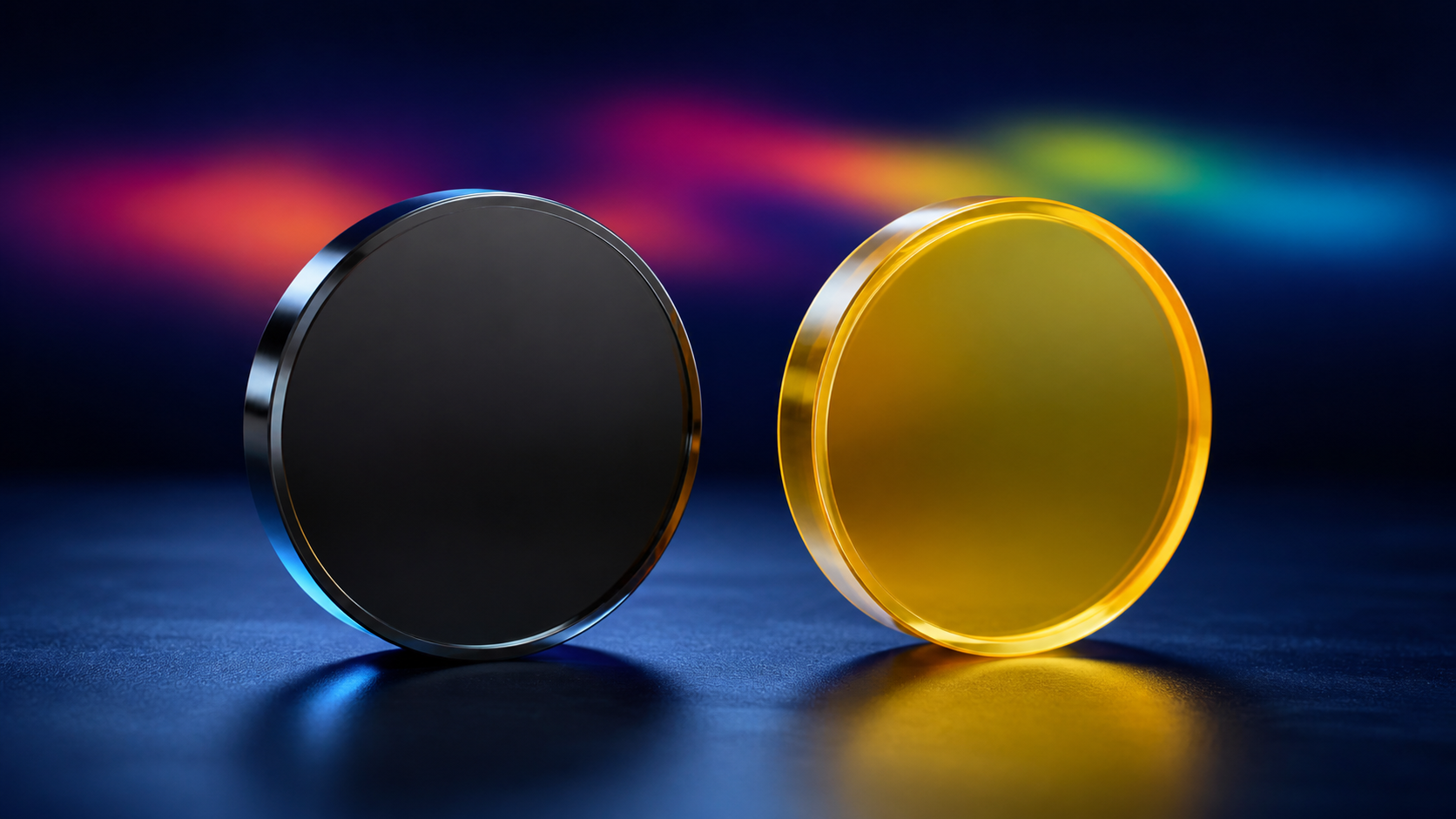
| Visible appearance | Opaque in the visible region | Yellow-orange and partially transmitting in the visible region |
| Common applications | LWIR thermal imaging, IR windows, lenses and filter substrates | MWIR/LWIR imaging, CO₂ laser optics, windows and lenses |
| Thermal sensitivity | Optical properties change significantly with temperature | Generally more suitable where broader spectral transmission is required |
| Mechanical consideration | Relatively hard but dense and brittle | Softer and requires careful handling and edge protection |
What Makes Germanium Suitable for Thermal Imaging?
Germanium optics are widely used in the 8–14 µm long-wave infrared (LWIR) band. This makes the material a common choice for thermal cameras, night-vision systems, temperature-measurement instruments and environmental sensing equipment.
Germanium’s very high refractive index allows an optical designer to obtain substantial optical power with comparatively shallow lens curvatures. This can support compact infrared lens systems, but it also creates high Fresnel reflection losses at uncoated surfaces. Anti-reflection coatings are therefore normally an essential part of a germanium optical design.
For exposed front windows, protective coatings such as diamond-like carbon (DLC) may be considered when abrasion resistance and environmental durability are important. Coating selection must still be matched to the required wavelength band, angle of incidence, operating environment and transmission target.
What Makes Zinc Selenide Different?
Zinc selenide optics offer a broad transmission range extending from part of the visible spectrum into the long-wave infrared. ZnSe is used for infrared windows and lenses, spectroscopic components and CO₂ laser optics operating at 10.6 µm.
Because ZnSe transmits some visible light, it can simplify alignment in systems that use a visible aiming or positioning beam together with infrared radiation. Its refractive index is lower than germanium, which changes lens curvature, thickness and aberration correction requirements.
ZnSe is softer than germanium and must be handled carefully during machining, cleaning, assembly and field use. Edge design, mounting stress and protective packaging deserve particular attention. Anti-reflection coatings are also important for controlling surface reflection and achieving the required system transmission.
Five Questions to Ask Before Selecting the Material
1. What wavelength band must the optic transmit?
For a dedicated LWIR thermal imaging system, germanium is often a strong starting point. If the system must cover a broader spectral region, transmit a visible alignment beam or operate at the 10.6 µm CO₂ laser wavelength, ZnSe may offer important advantages. The usable transmission of a finished component also depends on thickness and coating performance.
2. How will temperature affect performance?
Germanium has a comparatively large thermo-optic response. Its refractive index and absorption behavior change with temperature, so thermal modeling may be necessary for systems exposed to wide temperature ranges. Designers should evaluate focus shift, transmission loss and mechanical mounting conditions across the full operating environment.
3. Is visible alignment required?
Germanium is opaque to the human eye. ZnSe’s partial visible transmission can be useful when an operator needs to see an alignment beam or inspect the optical path. This difference can influence both system architecture and service procedures.
4. What environmental exposure will the optic experience?
A protected internal lens and an exposed external window have very different requirements. Consider abrasion, dust, moisture, cleaning, thermal cycling, mounting load and impact risk. Germanium may benefit from a durable DLC coating in demanding environments, while the softer surface of ZnSe requires careful mechanical and coating design.
5. What are the manufacturing and inspection requirements?
Diameter, center thickness, wedge, surface figure, surface quality, clear aperture and coating uniformity all affect manufacturability and cost. The highest specification is not automatically the best specification. Requirements should be tied to actual system performance and verified with an appropriate inspection plan.
When to Choose Germanium
- The design is centered on the 8–14 µm LWIR thermal band.
- A high refractive index is useful for a compact lens design.
- The component requires a durable environmental coating such as DLC.
- Visible transmission is not required.
- Temperature-dependent optical behavior has been evaluated in the system design.
When to Choose Zinc Selenide
- The application requires broad visible-to-infrared transmission.
- The system uses a 10.6 µm CO₂ laser.
- A visible alignment beam must pass through the same optic.
- The design requires MWIR or LWIR transmission with a lower index than germanium.
- The mechanical design can protect the softer material from damage.
Component Geometry and Coating Can Change the Decision
Material selection cannot be separated from component design. A thin protective optical window may prioritize durability and transmission, while an infrared lens must also control optical power, chromatic behavior and thermal focus shift. The coating must be designed for the exact wavelength band and incidence angle rather than selected as a generic add-on.
In some systems, the best solution may use different materials in different positions. An engineering review of the complete optical path can identify the right balance among transmission, image quality, environmental resistance, weight and manufacturing cost.
Information to Include in an RFQ
- Operating wavelength or wavelength band
- Component type and dimensions
- Surface figure and surface quality
- Wedge, parallelism or centration requirements
- Clear aperture
- Coating band, angle of incidence and transmission target
- Operating temperature and environmental exposure
- Inspection and documentation requirements
- Prototype and production quantities
Selecting the Right Infrared Material
Germanium is frequently selected for compact LWIR thermal imaging systems, while zinc selenide is attractive for broader spectral transmission, visible alignment and CO₂ laser applications. Neither material is universally better. The correct choice depends on the full optical, thermal, mechanical and manufacturing specification.
COE Sapphire supports custom germanium and zinc selenide windows, lenses and other infrared components from prototype through production. Request a quote or send your drawing and application requirements for an engineering review.